Mission and vision
People understand the purpose, direction, and priorities.
Our story
Family Personal Development began with one mother asking a difficult question: Are we being intentional enough about preparing our families for real life?
How it began
In 2019, an active-shooter training changed the way founder Toni Hall thought about preparedness. The training emphasized that people are more likely to respond effectively during a crisis when they have already discussed and practiced what to do.
As a mother, that lesson immediately became personal. Had everyone in the household discussed fire safety, water safety, intruders, emergencies, and the steps to take before panic set in? Could schools alone be expected to prepare children for every part of survival, stability, and adulthood?
The answer was clear: families need intentional preparation at home too. That realization became the beginning of Family Personal Development.
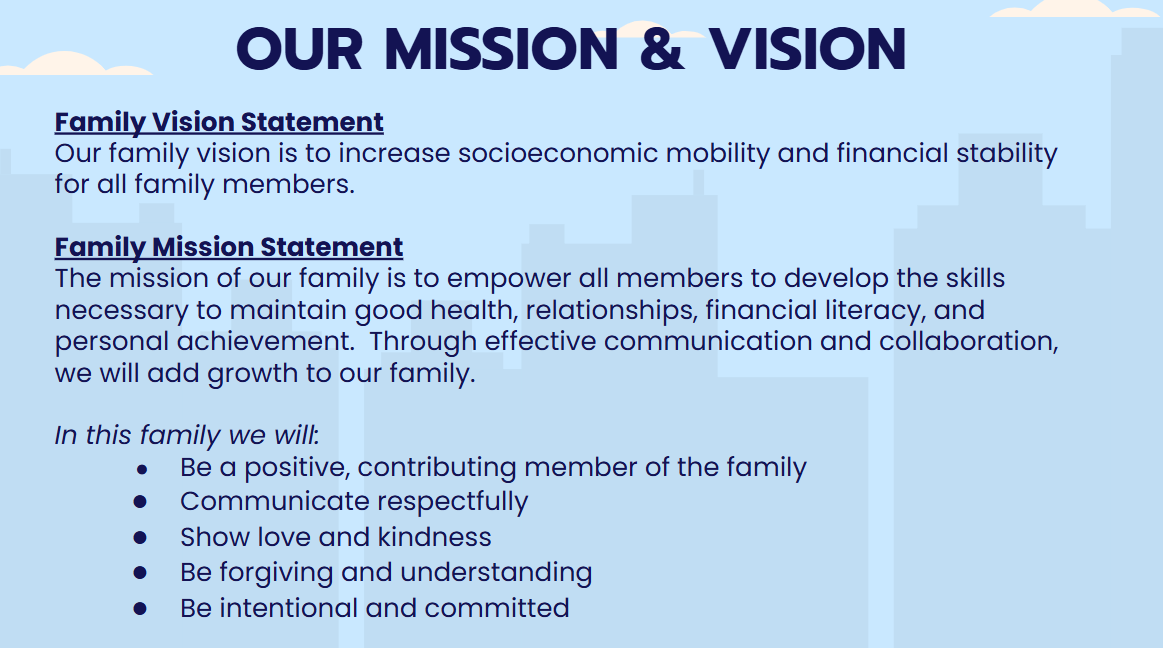
An early family mission-and-vision document helped turn household values into written expectations and shared direction.
The core idea
Schools, nonprofits, and businesses use mission statements, policies, meetings, roles, training, progress reviews, and systems to help people work together. Family PD translates those same practices into practical tools for home life.
People understand the purpose, direction, and priorities.
Families name what they value and what kind of life they are building.
Expectations are clear before a problem occurs.
Household expectations, boundaries, and systems are discussed openly.
Teams communicate, solve problems, and monitor progress.
Families share updates, name needs, celebrate wins, and adjust plans.
Our mission
Family Personal Development provides practical tools, education, and support that help households strengthen health, relationships, education, finances, and goals.
Our vision
We envision families—especially those navigating socioeconomic and systemic barriers—having the knowledge, support, confidence, and practical systems needed to build stable and fulfilling futures.
What makes Family PD different
Family PD looks at the entire household as a connected system. Growth becomes something family members discuss, practice, support, and review together.
Tools are designed for families to use together—not only for one person to read.
The focus is on usable meetings, policies, routines, plans, and conversations.
Family PD recognizes poverty, trauma, unequal access, and systemic challenges.
Families identify what is within reach and take small, intentional steps forward.
Toni grew up in Jacksonville, North Carolina, in a family where love and resourcefulness met needs even when money and systems were limited. Her own experiences with education, employment, financial instability, parenting, and professional growth shaped a belief that families deserve clearer access to the tools that organizations use every day.
Her work in education and Career & Technical Education strengthened the vision: practical skills, credentials, relationships, systems, and informed choices can expand opportunity across generations.
Family PD is now being rebuilt from Nevada as a nonprofit-centered initiative focused on family tools, workshops, education and career readiness, and community partnership.
Values that shaped the work
Be a positive, contributing member of the family and community.
Speak honestly, listen carefully, and communicate with respect.
Lead with love, compassion, dignity, and consideration.
Practice forgiveness, understanding, accountability, and growth.
Commit to meaningful action rather than waiting for change to happen.
The journey
Safety training leads to intentional family meetings, emergency planning, and household systems.
Family PD is introduced as a practical personal-development framework for the household.
The framework expands with deeper guidance on mindset, healing, the five pillars, and organizational practices at home.
The website, tools, programs, partnerships, and nonprofit foundation are being rebuilt for the next stage of impact.
Begin where you are
Start with one honest conversation, one useful tool, and one intentional step.